This week we'll take a look at what's happening in a few specific areas: the frontal and temporal lobes, the anterior cingulate cortex, fusiform gyrus, the amygdala, and the cerebellum. Remeber, overall in children with ASD there is a general early brain overgrowth that is thought to be linked to the dysfunction of two genes- PTEN and RELN. This overgrowth causes additional white and gray matter to be produced in the brain in addition to decreasing the brain's natural ability to go through experience dependent pruning of neurons. Also, the minicolumnar structures of the brain are affected in children with autism causing what could best be described as confusion between "important" and "unimportant" connections in the brain. With that short summary, let's move on to this week's fun stuff!
The frontal lobe sits just behind the forehead and extends back to just behind the temple. Commonly, the frontal lobe is described as the "executive" center of the brain- it is where thinking, planning, and goal formation takes place. The frontal lobe also houses the premotor and motor cortices. The left and right frontal lobes are slightly different in function- the left frontal lobe houses Broca's Area, the speech-motor area of the brain, whereas the right frontal lobe plays a large role in our ability to understand nonverbal communication. Here's where things start to get interesting for our children with ASD, normally the frontal lobes are the last to develop, with a 48% volume increase from the ages of 2 to 9 years old. For children with autism, we only see a 10% increase in frontal lobe volume during the same time period.
"Now, hold on..." you say, didn't I just point out that children with autism have early brain OVERGROWTH, now I'm saying that they don't have enough growth? The overgrowth that I talked about last week can start occuring anywhere from day 40 of gestation and into the first year of life. The same factors that account for the early overgrowth may account for the lack of growth in the 2-9 period. Remember how experience dependent pruning works- the repetative stimulation of certain connections in the brain drives us to become "societal specialits" in our culture. When there are too many connections surrounded by oligodendrocytes (remember those are the insulation that makes connections faster...for now), we almost never take the same route to get to the same behavior. When everything seems important, we can't easily prune away "unimportant" connections.
A very specific difference is seen in children with autism, the change in lateralization of the speech motor area. As I said earlier, the speech motor area (Broca's area) is typically developed on the left side of the brain, but in autistic children it is often misplaced in the right frontal lobe. Conceptually, this shouldn't really change the language abilities of a child- we have motor areas on both sides of the brain, so speech motor neurons located on the right side of the brain should work the same as those on the left side. The key here is that along with the change in lateralization of speech, the brain that is affected by autism also has poorly developed minicolumn structures contributing to a lack of communication between the two hemispheres of the brain, specifically between the language areas. On top of this, the switched specialization of speech may displace the ability to interpret nonverbal communication which is another characteristic of ASD.
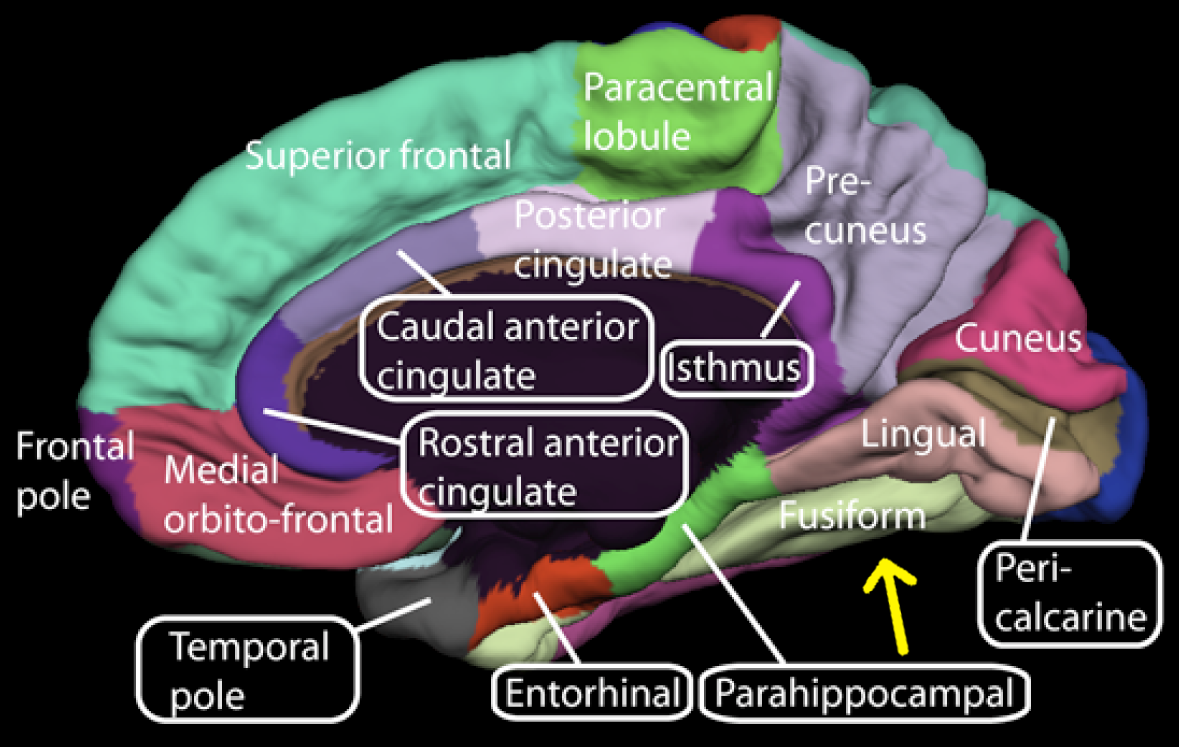 The fusiform gyrus is our next stop on the road to understanding autism. This area is typically responsible for color recognition, face and body recognition, word/number recognition, and within category identification. The left fusiform gyrus is responsible for recognizing "face-like" features in objects while the right fusiform gyrus determines if the object is/is not an actual face. Both sides need to work together for us to correctly identify objects in our environment. In children with ASD we find a mixed story for the fusiform gyrus- underactivation when it comes to unknown faces, and normal activity with known faces. It appears that there is a threshold to activity in the fusiform gyrus for children with ASD. This "threshold theory" of activation fits in with the overproduction/underpruning idea because these individuals need a greater stimulus (i.e. a face that they have seen over and over again) in order to have activity in this area. In other words, because there are so many ways to communicate with the fusiform gyrus, a known face will activate more neural circutry and therefore result in a "normal" activation pattern.
One of the most common observations of children with ASD is the performance of ritualistic and repetative behaviors. Through the study of the anterior cingulate nucleus we can begin to get a picture of why these behaviors exist. The anterior cingulate nucleus plays a large role in response inhibition, determining the difference between "self" and "others", and error detection. Interestingly, research has found that the anterior cingulate cortex is hypoactive in children diagnosed with ASD. It is now thought that, instead of isolating "self" vs. "others" and ignoring social cues, these children may be unable to divide themselves from the actions of others.
Many of the areas already presented depend on the amygdala for initial activation. The amygdala acts as a gateway for facial and emotional recognition, enhancement of memory for emotional events, and predicting reward values. Since it has such a key role in influencing activity in the frontal and temporal lobes, the fusiform gyrus, and the anterior cingulate nucleus, the amygdala has been highly researched for it's link to autism. Similar to the story thus far, the amygdala in children with ASD shows enlargement prior to age two, but a lack of growth after the age of two. While the size of the adolescent and adult amygdala is roughly equal between children diagnosed with ASD and their age matched "norms", the timing of amygdala growth is critical to the behaviors expressed. Take a minute to think of the things that are scary to a two year old...a new location, being left alone without mom or dad, bright lights, loud noises, etc. When a two year old reacts to these stimuli by screaming and crying, we understand, but when an eight year old diagnosed with ASD reacts in a similar fashion, we say that it is inappropriate behavior. The eight year old is simply reacting to the situation with the amygdala that has not grown since he was two. More studies need to be done in this area, but I wouldn't be surprised to find a link between high cortisol levels and increased early enlargement of the amygdala.
Our final stop on the road this week is the cerebellum, commonly associated with balance and equilibrium, but this structure also plays a large role in working memory, online movement corrections, and is highly active during the initial stages of movement learning. In studying the cerebellum of patients diagnosed with ASD, researchers have found an increase in cerebellar volume proportionate to overall brain volume. Other findings related to the cerebellum have been inconsistent, with some studies finding increased cell density and others finding decreased cell density. It appears that this is an unfolding story and the cerebellum could be one of the areas that we see good developments in the research in years to come.
So, now that we've explored the structures involved in autism, we need to gel this story together. No structure in the brain works in isolation, it is the concert of all these structures working together that creates the behaviors that are expressed on a regular basis. Through the understanding of what parts each structure plays, we get a better understanding of the whole concert. One of the most common behaviors associated with ASD is that of stereotyped behaviors, repetative behaviors that the child displays for any number of reasons. Tracing the activation through the structures that we have discussed, it would appear that the first structure involved would be the amygdala, which, due to it's enlargement, overactivates in response to a stimulus that the society would call "normal". This overactivation is then passed on to the fusiform gyrus, perhaps resulting in overriding the ability to recognize what is "self" and what is "other". The overactivity in the amygdala is also passed on to the frontal lobe through the myriad of connections that the frontal lobe has yet to prune away through experience dependent learning. Now the frontal lobes are active, yet recieving contradictory signals, and since speech has been mapped onto the right side of the brain (as opposed to the left) and the right and left sides are unable to communicate in order to solve the overactivation problem, the child begins to move in a repetative manner in an attempt to "cancel out" the stimulus that resulted in overactivation in the first place. Finally, the cerebellum comes into play because it is trying to correct the movement that is traveling from the motor cortex in the frontal lobe, but since the error detection matrix of the anterior cingulate nucleus is not working properly, the messages that are recieved in the cerebellum are contradictory (stop, go, stop, go, stop, go). GREAT, what do we do about this?
First of all, understanding is a big part of dealing with what's going on. Knowing that the amygdala is reacting like a two year old's will help us to limit the environment and the number of stimuli. Think about what a two year old likes and dislikes, what is scary and what creates joy for a two year old, then we need to temper that with the understanding of which brain areas are working at age level. There is a compromise to be found here by speaking to the two year old while serving the age appropriate areas. The age appropriate areas can tune in to help the other areas to go through experience dependent pruning once they understand that is their job. Through providing a consistent environment with stimuli that are predictable, regular, and rewarding, the brain can and will adapt to society with which it interacts. Finally, we need to understand that two year olds do not become eight year olds overnight, it's a process of maturation and we can't skip steps along the way.
Next week, we'll take a look at the neurochemicals involved in ASD, so get ready for serotonin, dopamine, glutamate and neuropeptides!

No comments:
Post a Comment